In short
Shopify works well in both Slovakia and Czechia, but not in the same way. The biggest difference is payments: a company registered in Czechia can use Shopify's own payment gateway (Shopify Payments), a company registered in Slovakia cannot. That one fact decides the fee on every order, Apple Pay, payments in euros and Czech crowns, and several other choices.
This guide covers everything to sort out before launch: prices, payment gateways, cash on delivery, pick-up points, invoices, VAT, eKasa and EET, consumer law including the contract withdrawal button, and sales channels. Every point has a source, and the data is checked as of 3 November 2026. App prices and rules change, so check them again before making a decision.
This article is not tax or legal advice. Discuss VAT, registrations and the wording of your terms and conditions with an accountant or lawyer.
Shopify pricing in Slovakia and Czechia
Shopify prices depend on the country of the store. A Slovak merchant pays in euros, a Czech merchant in Czech crowns (CZK). Prices are per month:
| Plan | Billed yearly | Billed monthly |
|---|---|---|
| Basic | €19 | €27 |
| Grow | €56 | €74 |
| Advanced | €289 | €384 |
| Plus | from €2,100 | |
| Plan | Billed yearly | Billed monthly |
|---|---|---|
| Basic | CZK 499 | CZK 670 |
| Grow | CZK 1,370 | CZK 1,830 |
| Advanced | CZK 7,130 | CZK 9,510 |
| Plus | from €2,100 | |
New stores get a 3-day free trial, then 3 months for €1 a month (CZK 25 in Czechia). The pricing page does not say how Shopify charges VAT to Slovak and Czech companies, so check your first invoice or ask your accountant.
Apps come on top of the plan. The apps mentioned below mostly cost $5 to $40 a month. They are billed in US dollars, and their prices change more often than Shopify's own.
Shopify Payments: Czechia yes, Slovakia no
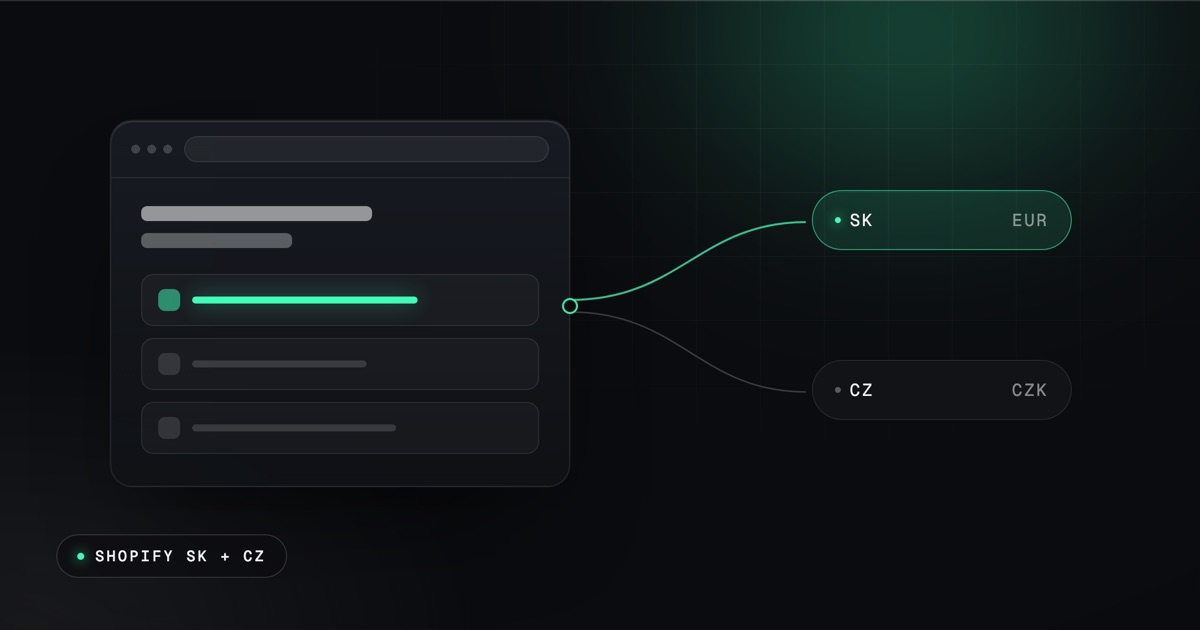
Shopify Payments is Shopify's own payment gateway. According to the official list of supported countries, companies in Czechia can use it, companies in Slovakia cannot. Shopify has not announced when it will launch in Slovakia.
For a company based elsewhere: the same list includes Germany, Austria, Switzerland, Poland and Hungary, so a company registered in one of those countries can use Shopify Payments when selling into Slovakia and Czechia.
For a store run by a Slovak company, this has three consequences:
- A fee on every order. When payments go through a third-party gateway, Shopify charges 2% on the Basic plan, 1% on Grow, 0.6% on Advanced and 0.2% on Plus. This comes on top of the gateway's own fee.
- One currency. Shopify can process payments in several currencies only with Shopify Payments or with the Adyen gateway. A Slovak store using any other gateway therefore accepts payment only in the store's default currency. It can display prices in Czech crowns, but the customer pays in euros.
- No local payment methods through Shopify. On the Slovak pricing page, local currencies and local payment methods carry the note “Vyžaduje sa služba Shopify Payments“ (Requires Shopify Payments).
A Czech company with Shopify Payments pays from 1.9% + CZK 6.50 per card payment on the Basic plan (1.8% on Grow, 1.6% on Advanced), and from 2.9% + CZK 6.50 for Amex and cards issued in other countries. The Shopify fee for third-party gateways does not apply to it, and it can accept both euros and Czech crowns in one store.
What can a Slovak store that also wants to sell to Czechia do? There are three options: one store in euros with converted prices shown for display only, a separate store for each currency, or running the business through a Czech company. The cost difference is shown in a worked example in the article Shoptet or Shopify.
Payment gateways for Shopify in Slovakia and Czechia
These gateways can be used with Shopify by a store based in Slovakia or Czechia. Shopify lists them in its provider directory, or they have an official app:
| Gateway | Apple Pay and Google Pay | Note |
|---|---|---|
| Stripe Card Payments | yes | Visa, Mastercard, Amex and other cards. If it does not appear in the admin, Stripe support sends the installation link. |
| Comgate | no | Official app, more than 50 payment methods including bank buttons and QR payments. In Czechia also the buy-now-pay-later options Twisto and Skip Pay. Fees are negotiated with Comgate. |
| GoPay | no | Official app, cards and bank transfers. Recurring payments are not supported. |
| Revolut | no | Cards, Pay by Bank and Revolut Pay, payout the next day. |
| PayPal | no | PayPal Express Checkout as an additional payment option. |
Apple Pay and Google Pay do not work on Shopify through Comgate or GoPay, even though some websites claim they do. Comgate says so explicitly in its Shopify guide, and GoPay says the same in its app description. The simplest way to add Apple Pay and Google Pay to a Slovak store is Stripe Card Payments.
No official Shopify integration for ThePay, Besteron, TatraPay or TrustPay could be found as of 3 November 2026. According to its documentation, Barion connects through a manual payment method and a script in the checkout. However, Shopify switched off scripts on the order status page on 26 August 2026, so check that such an integration still works before relying on it.
Cash on delivery on Shopify
Cash on delivery is set up in Shopify as a manual payment method. Shopify does not charge its third-party gateway fee on manual payments, so a Slovak store loses nothing extra on cash on delivery or bank transfers.
Shopify does not add a cash on delivery surcharge by itself. This is handled with a separate shipping rate, for example “with cash on delivery”, or with an app. When setting the surcharge, keep in mind that Slovak consumer protection law does not allow charging more for a payment method than the merchant's actual costs.
Why cash on delivery matters: according to Shoptet data, it accounts for more than 43% of orders in Slovak online stores. In Slovakia, it is worth offering.
Shipping and pick-up points
Pick-up points and parcel lockers are a standard delivery method in both Slovakia and Czechia. Shopify has one important limitation here: custom elements in the shipping step of the checkout are only available on the Plus plan. On the Basic, Grow and Advanced plans, the customer therefore picks a specific pick-up point on the thank-you page after the order, not during checkout.
Carriers do not have their own official Shopify apps. Pick-up point selection and shipping labels are handled by third-party apps:
- Zásilkovna • Packeta Pickup (Digismoothie): pick-up points, shipment export, cash on delivery.
- ShipD: labels for Packeta, GLS, DPD, Balíkovna, PPL, Slovenská pošta, Česká pošta and others.
- Globe Pickup Points: more than 65 carriers, including SPS and Slovenská pošta.
- Atlas Pickup Points: more than 60 carriers, selection in the checkout on the Plus plan.
- Pickup Points CZ/SK/HU: Packeta, GLS, DPD, PPL and Balíkovna.
Beware of old tutorials that handled pick-up point selection with a script in the checkout. Scripts on the order status page stopped working on 26 August 2026, and other scripts on the online store will stop running on 1 March 2027.
Invoicing and accounting
In practice, invoices that meet Slovak and Czech requirements are handled on Shopify by connecting an invoicing system through an app. None of these apps are made by Shopify, and most are not made by the invoicing system itself either:
- SuperFaktúra: app by the developer Make It Easy!, in Slovak and Czech.
- Fakturoid: app by Digismoothie; Fakturoid has its own guide for the connection.
- iDoklad: app by Make It Easy!; iDoklad requires a higher plan with API access.
- Pohoda: order export to XML (XML Exporter for Pohoda), not an official Stormware product.
- ABRA Flexi: a separate connector app.
No ready-made integration between Billdu and Shopify could be found. Money S3 has a universal e-shop connector via XML.
Slovak stores that are VAT payers and sell to businesses face mandatory e-invoicing from 1 January 2027. According to the Slovak Financial Administration, invoices to other Slovak companies will be sent in a single electronic format over the Peppol network. Invoices to consumers are not affected. When choosing an invoicing app, it is worth checking that it will be ready for this.
VAT, OSS and taxes in Shopify
| Slovakia | Czechia | |
|---|---|---|
| Rates | 23%, 19% and 5% | 21% and 12% |
| Mandatory registration | turnover above €50,000 a year, immediately when €62,500 is exceeded | turnover above CZK 2,000,000 a year, immediately when CZK 2,536,500 is exceeded |
In Slovakia, some foods (for example sweets, ice cream and sweetened drinks) moved from the 19% rate to 23% on 1 January 2026. If you sell such products, check the tax rates in your store.
Selling to another EU country. As long as sales to customers in other EU countries stay below a combined €10,000 a year, you charge the VAT of your own country. Above that threshold, you charge the VAT of the customer's country and declare it through a single OSS (One-Stop Shop) registration in your own country. A Slovak store selling more than €10,000 a year to Czechia therefore charges Czech VAT, and vice versa.
Taxes in Shopify. Since 13 May 2026, new stores in the EU can no longer use the simple Basic Tax mode. The remaining options are Shopify Tax or manual tax settings. Shopify Tax is free up to €100,000 in sales; for stores created on or after 13 May 2026, this is a lifetime threshold. After that, it costs 0.25% per order, capped at €0.99. OSS is switched on in Shopify in the tax settings for the European Union.
The tax settings also determine whether store prices include VAT. For consumers in Slovakia and Czechia, they should.
eKasa and EET 2.0
Slovakia. A new Act on recording sales (384/2025 Z. z.) has applied since 1 January 2026. Sales of goods paid by cash on delivery are explicitly exempt from recording in eKasa, the Slovak electronic cash register system. According to the Slovak Financial Administration, payments made only by bank transfer outside the point of sale do not have to be recorded in eKasa. Expert sources advise the same for online card payments through a payment gateway, which the Financial Administration does not mention explicitly. If you offer in-person collection with payment on the spot, that is a sale that must be recorded.
Czechia. The President signed the EET 2.0 act (electronic sales records) on 17 September 2026. The obligation to record sales applies from 1 January 2027, with January as a trial month. For an online store, payments through a payment gateway, QR code payments on the website and bank transfers are not affected. Cash on delivery collected by the carrier and sent to the merchant's account is not recorded either. Watch out for your own delivery with payment on handover: that may be a payment that has to be recorded.
Consumer law and the withdrawal button
The rules for distance selling in Slovakia and Czechia are similar, but differ in the details:
| Slovakia | Czechia | |
|---|---|---|
| Withdrawal from the contract | 14 days from receipt of the goods | 14 days from receipt of the goods |
| Refund | within 14 days of the withdrawal notice | within 14 days of withdrawal |
| Warranty claims | defects can be claimed within 24 months, repair within 30 days at most | defects can be claimed within 2 years, handled within 30 days |
| Language | information and documents in Slovak | written information in Czech |
| Withdrawal button | mandatory since 19 June 2026 | the law is still being passed |
The withdrawal button in Slovakia. Since 19 June 2026, an online store must have a function labelled “odstúpiť od zmluvy tu“ (withdraw from the contract here) or similar, clearly visible and available for the whole withdrawal period (§ 20a zákona 108/2024 Z. z., Section 20a of the Slovak Consumer Protection Act No. 108/2024). In it, the customer enters their name, order identification and email, and confirms with the button “potvrdiť odstúpenie od zmluvy“ (confirm withdrawal from the contract). The merchant must then send a confirmation with the date and time without delay. Shopify does not offer this function by itself, so it has to be added with a form or an app.
In Czechia, the button is not yet in the law. The Chamber of Deputies passed the amendment on 14 October 2026, and the Senate received it on 2 November 2026. It is worth preparing the button in advance.
Other obligations that are easy to forget on Shopify:
- The order button in Slovakia must say “objednávka s povinnosťou platby“ (order with obligation to pay) or similar.
- Discounts: with every discount, you also show the previous price, meaning the lowest price in the 30 days before the discount.
- Terms and conditions: according to Shopify, its policy templates are for information only and are not prepared for Slovak or Czech law.
- Product safety (GPSR): since 13 December 2024, a product listing must show the manufacturer with a postal and electronic address, product identification and safety information in the language of the country. Anyone selling under their own brand is the manufacturer.
- Accessibility: accessibility requirements for online stores have applied since 28 June 2025. In Slovakia, the law does not apply to services provided by microenterprises.
- Cookies: Shopify's built-in banner is switched on for visitors from the EU if the store has active markets in the EU. Pixels added manually or through apps, such as Meta or TikTok, may not be covered by it. A banner from another provider must be connected to the Shopify Customer Privacy API.
Languages, currencies and markets
Both Slovak and Czech have a translated checkout and system texts in Shopify. A store on the Basic to Advanced plans can sell in up to 20 languages.
Shopify's Translate & Adapt app can translate automatically, but stores based in Slovakia and Czechia can auto-translate a maximum of 2 languages, without automatic syncing of changes. Stores based in Germany, Austria, Switzerland, the UK or Ireland, among other countries, have a limit of 8 languages. Machine translation always needs a human read-through: both customers and the law expect clear Slovak and Czech.
Another language or country is added through Markets. It can run in a subfolder (for example /cs-cz), on a subdomain or on its own .sk or .cz domain. Shopify recommends subfolders for most stores; a separate domain gives the strongest local signal but has to be managed on its own. Shopify sets up the links between language versions for Google (hreflang) automatically.
Currencies follow the same rule as Shopify Payments: a Czech store charges both euros and Czech crowns in one store, a Slovak store only one currency.
Heureka, Google and Seznam
- Heureka: the free Heureka Trust Badge app handles the “Overené zákazníkmi“ (Heureka's customer-review certificate) certificate, and an app such as Heureka XML feed provides the product feed for Heureka SK and CZ. The free Heureka & Zbozi Tracking app collects conversion tracking for Heureka, Zboží and Sklik.
- Google Shopping: Google Merchant Center supports Slovakia in euros and Czechia in Czech crowns, with Slovak and Czech as languages.
- Seznam: in October 2026, according to StatCounter, Seznam had a 13.07% share of search engines in Czechia, and Google 80.07%. For the Czech market, a feed for the price comparison site Zboží.cz and ads in Sklik are therefore also worth it. No official Seznam app for Shopify could be found; tools such as Mergado can create the feed.
- Glami: for fashion, there is an app with a feed and a pixel.
Business customers: IČO, DIČ and B2B
The Shopify checkout has no separate fields for IČO (company registration number) and DIČ (tax ID), and outside the Plus plan, custom fields cannot be added to it. There are two workarounds: fields in the cart that carry over to the order and from there to the invoicing app, or the Company field in the checkout.
The checkout does have a field for the VAT number. However, validating the number through the VIES system works only with Shopify Tax. The reverse charge applies only to shipments to a country other than the one the warehouse is in: a Slovak company buying from a Slovak warehouse pays VAT, a Czech company does not.
If you sell to businesses at scale, Shopify B2B is no longer only for Plus. It is also available on the Basic, Grow and Advanced plans, with a maximum of 3 price catalogues.
Pre-launch checklist for Slovakia and Czechia
- Shopify plan and company country: with a Slovak company, budget for the third-party gateway fee.
- Payment gateway, Apple Pay and Google Pay, cash on delivery as a manual payment.
- An app for pick-up points and carrier labels.
- An invoicing app and readiness for e-invoicing from 2027 (Slovakia, VAT payers).
- Shopify Tax, prices including VAT, OSS when selling to another country above €10,000.
- eKasa for in-person collection; in Czechia, EET 2.0 from 2027 for payments on the spot.
- Terms and conditions and a returns and complaints policy under local law, not from a template.
- The “odstúpiť od zmluvy tu“ (withdraw from the contract here) button in Slovakia, prepared in advance in Czechia.
- The “objednávka s povinnosťou platby“ (order with obligation to pay) button and the previous price on discounts.
- Manufacturer details and safety information on products.
- A cookie banner connected to the Shopify Customer Privacy API.
- Language versions checked by a person, markets and domains.
- Feeds for Heureka, Google and, in Czechia, Zboží.cz.
- A test order with every payment and shipping method, including cash on delivery.
If you already have a store, an e-shop audit goes through these points for you and sorts what to fix first. You can test your homepage for free with Webcheck.
Sources, checked 3 November 2026: Shopify pricing (SK), Shopify pricing (CZ), Shopify Payments countries, multi-currency payments, Comgate for Shopify, GoPay in the Shopify App Store, Stripe Card Payments, manual payments in Shopify, checkout extensions, script deprecation, VAT rates (Slovak Financial Administration), VAT registration, eKasa, e-invoicing (Slovak Financial Administration FAQ), cash on delivery based on Shoptet data (SITA), EET 2.0, OSS, Shopify Tax, Slovak Act 108/2024 Z. z., Czech Act 634/1992 Sb., Chamber of Deputies print 53, Translate & Adapt, cookies in Shopify, StatCounter, Shopify B2B.